
Art and Magic

Among other things, Michael Saltz is the Board President of the Art School of Columbia County
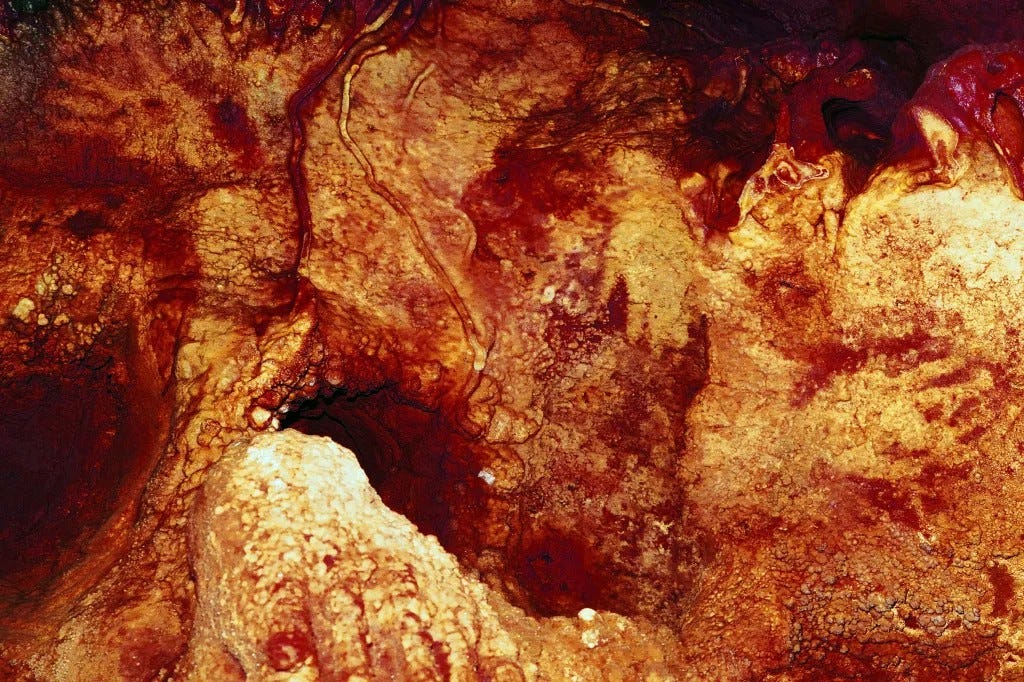
Sixty-five thousand years ago, a Neanderthal ancestor of ours stood in a cave in Cáceres, Spain. Using someone’s hand as a stencil, he (or she) painted its silhouette on the cave’s wall. Discovered only in 1951, it’s the oldest known visual representation of drawing. Over thousands of years, cave and rock face paintings—depicting humans, animals, and scenes from our collective past—have been found at hundreds of sites across every continent. These paintings, along with other archeological discoveries such as skeletons and tools, provide our only glimpses into the lives of our earliest ancestors.
These paintings tell us stories as intended, even if we can only guess the true meaning of the tales they tell. They are the first physical evidence of communication between human-like beings. If they had a written language, we’ve seen no evidence of it, nor do we know anything about their spoken language or its complexity, assuming they used anything we would consider language today. Yet, we have communications from those ancient years—the art of our prehistoric ancestors who tried to tell their stories to everyone who saw them, including us.
What we know, or can at least surmise, is that art—the physical representation of everyday objects that were drawn or painted on rock surfaces—evolved into written language by turning pictures of things into increasingly abstract symbols representing physical objects, ideas, and sounds. Consider the ancient Sumerians and cuneiform, the Egyptians and hieroglyphics, the Israelites and Hebrew. Eventually, these systems developed into the Roman alphabet that we use today. Similarly, in Asia, pictographs evolved into scripts like the calligraphic languages of China and Japan, which are quite different from our alphabet. But they also developed into what we now call art.
Art — any visual art like drawing, painting, or collage, among the myriad forms we typically call art—is our most elemental form of communication. It requires no more formal academic education than our distant Neanderthal ancestors had. It doesn’t require an elementary school diploma, a high school GED, a college BFA, or a PhD in Art History. Any blank physical space, such as a piece of paper or a rock, will suffice. And it needs something to make a mark on that space, like a pencil, a chisel, or a brush. And it needs you. Most of all, you.
Many years ago, I saw an extraordinary exhibition of artwork created by people with little or no education in New Orleans. I remember going to Chicago to see a heartbreaking exhibition of paintings by Vietnam vets, none of whom were professional artists, in the wake of that war. An artist couple in rural Kentucky whose realistic representations of their community always had Satan lurking in the background. The work of Argentinian-born Claudia Bernardi, whose paintings always contained the ghostly remains of those whose bones she had helped uncover from mass graves in the wake of massacres in Argentina and El Salvador. I remember the emotional power of ceremonial masks created by supposedly primitive African tribes. They are as memorable and moving to me as anything by any artist whose work sells for hundreds of thousands or millions of dollars.
When you get down to it, what is art—any art? How is art created? How do you draw a picture? A picture is simply, or not so simply, the result of a conversation, a dialog between you and what you are observing. Maybe you’re looking at a flower. What do you notice? What are its lines, its shape, its shadows, its colors, and how does it relate to what’s around it? And what do you think about what you see? What do you feel? How do I translate that onto paper so someone else can see what I see, feel what I feel? So many questions, so many possibilities. But above all, I believe it’s a way of discovering yourself—what you think and feel about yourself and the world around you. And if nothing else, it’s a way of saying, “I am here.”
Art, I believe, is the closest we come to true magic — the transformation of one thing into another, a once blank piece of paper that is now transformed into something utterly different. And you become different as well, or at the very least better defined to yourself. Transmutation. The transformation of base metal into gold. The transformation of a piece of paper into a work of art. Magic.
Once you start to draw or paint and look at an object more closely than you ever have before, you find that the things you discover about lines, colors, shapes, and light become part of how you see everything ever after. Transformation. And the more skilled you become, the more you can see, and the better you are able to translate what you see onto that blank piece of paper. Again, transformation. Change. You may or may not come to think of yourself as an artist, but that’s just a label. The change for you may be large or small, but it doesn’t matter because, in some ineffable way, you will have become someone different, however minor.
Though I don’t see myself as an artist, certainly not one who draws or paints very well, I joined the Art School of Columbia County for all these reasons. The teachers (all working professional artists) were universally encouraging and eager to show me different techniques. But most of all, they wanted to help me develop whatever skills I had, just as they did with those who were far more accomplished than I am.
I take the school’s motto, “Transforming Lives Through Art,” seriously. I believe art — the making of art, the doing of art, the creation of art—is for everyone, child or adult, no matter their socioeconomic background, education level, race, religion, or gender identity. I believe it matters. I believe it is for you.